Not everyone needs best-in-class software. So why not purchase the best? Just because a vendor sits in the upper right quadrant doesn't make it the best choice for you. You may need to consider your budget, your culture of organic open source IT, or maybe you want to focus on your core competencies which isn't BI development.
Even the Fortune 1000 should look outside the typical "short-list" of BI vendors. And then there are the small to mid-sized businesses with typically limited IT resources.
Thank you Fayu for this post from The Data Doghouse giving options beyond the best-in-class vendors. Here's my shortened list of options.
BI with SaaS - cost effective, minimum internal IT resources required, All you can eat BI.
Open Source BI - cost effective, typical BI technical architecture, requires internal IT support, Open source validated.
BI appliances - simple solution from customers perspective, BI in a box that sits at your site.
Microsoft Excel - least expensive, inherent problems with taking this approach but works for some.
To help with others doing their research on these vendor categories, if you know of companies that fall within these categories, send them my way or post your own comment. I know I could learn something from these new offerings too.
Wednesday, November 29
Friday, October 20
Executive reporting? free ebook (for now)

Executive reporting is changing. Or rather the way executives are doing organization-wide reporting is. Consuming information is at an all time high. Executives want to act before they have to react to the market, competition, and other conditions.

This Executive Reporting ebook I'm publishing is not about selling you on one service or another. Nor does it recommend a product or tool. Instead it is about giving you tried ideas that worked for management groups in government and private firms. In a condensed, easily consumable form.
Download pdf here.
I'm sure this ebook is incomplete. But that's why I left the option open for future issues. I hope this encourages you to think and pay attention to what other organizations are doing. And it's free. And it is small enough to email to colleagues or post on your own site.
Thanks for reading.
Marketing matters
Many vendors don't get it. How many vendor demonstrations have you sat through and all you came away with was how their products are great. The best features. Better than the competition. I bet they are in the top right corner of the Gartner quadrants too.
It shouldn't be about how their product functions. Unless the "how" is what you want to know. Sometimes techies and vendor sales people focus on the technology when marketing to business people. Check out John Dodds post ("Geek Marketing"). Following even one or two of his top ten will help with not speaking geek. "Translate the creations of the uncommunicative (techies) into the needs of the untechnical (biz people)".
After all it should be about how the product can work for you or your business.
It shouldn't be about how their product functions. Unless the "how" is what you want to know. Sometimes techies and vendor sales people focus on the technology when marketing to business people. Check out John Dodds post ("Geek Marketing"). Following even one or two of his top ten will help with not speaking geek. "Translate the creations of the uncommunicative (techies) into the needs of the untechnical (biz people)".
After all it should be about how the product can work for you or your business.
Tuesday, October 10
An Engineer, economist, and a marketer walk into a room
Eirik has a excellent riff on "When will a new technology break through?"
His "most important thing" is very important for BI users (I mean executives, analysts, managers, and frontline staff). Design, good design, will help with users accepting and using BI and business performance measurement and pretty much anything you want used by people.
His "most important thing" is very important for BI users (I mean executives, analysts, managers, and frontline staff). Design, good design, will help with users accepting and using BI and business performance measurement and pretty much anything you want used by people.
Friday, October 6
Creative BI: people want it

Ever have the feeling that some people are reacting to BI with a "oh, it's that again" attitude. Ever heard a user say, "I get what I need, then I get out quick." Not in your department, you say?
BI could be getting stale for people. BI can be known as a difficult tool that provides more information than is really needed. And is delivered to far too few. Perhaps in some cases but there are ways to change that.
Impress users with the "wow" factor. But how?
Design and innovation. Chas Martin is finding that creative, innovative designers are increasingly more relevant within companies. With BI, it's about the user interaction portion. Use something other than the generic out-of-the-box functionality. Boring.
Find out what the winners of the TDWI Best Practices awards have done to impress. They raised their standards and the results benefited users.
BI can be more than pushing mounds of data to users. The experience can be about seeing the information you want quickly and easily. People don't have the luxury of spare time. By helping them get to the point in less time, they may use it more often next time.
Friday, September 29
Microsoft could cost you more

Good news for some; for the rest, it could take focus and money away from projects and improvements for performance measurement and BI systems.
The IDC study (paid by Microsoft) concluded that Microsoft's new Vista operating system (in the European Union) will require billions of dollars and more IT employees to focus on the upgrade. Some will argue the benefits of the new software outweigh the costs. Really?
Silicon Valley Sleuth shares their comments and here's the IDC study.
First some numbers. For every Euro that is spent on Windows Vista, companies on average will spend another 14 Euro on downstream economic activity (hardware, services and third party software applications). This is not going to be a simple upgrade of Windows. CIOs and IT budgets will feel the financial hit.
And that's a staggering proportion. If everytime a client came to me and asked for the latest and greatest and I told her "it will cost you 14 times the software costs to complete", I wouldn't have her as a client! But if I had a monopoly like Microsoft, then I guess she couldn't turn to anyone else.
Now the benefits. According to IDC, one of the positive impacts for the economy is the 50% increase in IT jobs needed for Vista-related work. More jobs are welcomed but realistically that will mean less IT people and budget focused on content and systems to support business people.
Some may argue that Vista benefits business people, but I haven't come across an executive yet that asked for the latest Windows patch.
For those who have some influence over IT spending, be informed (warned?) that business people may be the ones losing out with Microsoft's new Vista upgrade.
Wednesday, September 20
BI detects fraud
Some of us are willing to pay anything to have chiropractors fix our necks and backs. Then there are those who scam insurance companies with false claims of injury. I'm assuming this is a big business if you want to be on that side of the law. Fighting back are insurance companies using BI to track down fraudulent claims and unethical chiropractors.
This is what BI should be doing. Focusing on how to right a wrong. Learning how to help people in society. Protecting a business from economic downturns. Increasing market share of a business. What contribution is your information providing you, your organization, or society?
This is what BI should be doing. Focusing on how to right a wrong. Learning how to help people in society. Protecting a business from economic downturns. Increasing market share of a business. What contribution is your information providing you, your organization, or society?
Tuesday, September 19
Executive reports on your Blackberry

When you need to check the performance (or under-performance) of a business unit, geographic region, or sales numbers for a department, it is difficult to do this on the road. Shawn writes that Cognos can now do this for your Blackberry.
Being less tied to your computer or laptop for information will keep you mobile (especially for those who spend a great deal of time traveling or going to meetings 8 hours a day). You want the "right" information pushed to you on a regular basis without involving a bunch of people or asking IT.
Information you want; when you need it.
The key will be giving executives information that works on the 3 inch Blackberry-type screens. The days of the "one-page-wonder" where all your information is on one report will be history. But replaced with simple, clear, concise, to-the-point, and actionable information.
People will become accustom to charts and data that relate to key performance information. When people are accountable and gauged on a small number of key performance measures, people tend to focus.
There is a downside to being too focused though. More about that later.
Where is your pipe dream

Lyndsay Wise writes how "business performance management (BPM) is the next generation of business intelligence". Not so sure this is true when Hyperion is already adding Google search to their BPM and BI toolsets.
The next wave for BI, which includes BPM, will probably focus on two objectives:
1) Simplify BI so non-tech people can actually use it. Google search is a start.
2) Once it is easier to use, BI will quickly be pushed out to more people within an organization.
BI and BPM can be a huge benefit to a business. At this point, only 20% of people gain this benefit.
Imagine your business using a pipe with two open ends. At one end, information enters the pipe. Invoices, customer support, case management... data goes in. The pipe makes the magic happen and information should come out the other end. (The pipe is a metaphor for BI technology, in case it wasn't clear.)
You want the information coming out to be at a good flow and the pipe at the correct width. I suspect most have the tap on too high. Or not enough flow. The point being that every organization has different needs. And people within a company also have different needs.
Do a quick check. Are your executives receiving the same flow of information as people on the front line? Different information and tools for different folks.
Friday, September 8
Getting started
Prospect: "We loved your pitch from yesterday for a BI solution and we want to start today."
Consultant: "Sorry but we don't have anyone available at this time. But we could start in 45 days."
Vendor: "If you liked our proposal, then we are ready to discuss moving forward today."
Client: "Your proposal is what we want and everyone here agrees with it. But we want to revisit the design."
Employee: "The client says they are ready to start so I'll need Bob to uncover details for a proposed plan."
Boss: "I don't think you need Bob yet. Wait until the project starts and we have a contract."
[the plan submitted was rejected due to inaccuracies.]
Sometimes getting started is the hardest thing to do even when all the writing is on the wall. Actual conversations (luckily not all mine) about the status quo and taking that next step.
Consultant: "Sorry but we don't have anyone available at this time. But we could start in 45 days."
Vendor: "If you liked our proposal, then we are ready to discuss moving forward today."
Client: "Your proposal is what we want and everyone here agrees with it. But we want to revisit the design."
Employee: "The client says they are ready to start so I'll need Bob to uncover details for a proposed plan."
Boss: "I don't think you need Bob yet. Wait until the project starts and we have a contract."
[the plan submitted was rejected due to inaccuracies.]
Sometimes getting started is the hardest thing to do even when all the writing is on the wall. Actual conversations (luckily not all mine) about the status quo and taking that next step.
Unique
There are 44,200,000 Google matches for "Information Management". "Business Intelligence" beats that with 55,600,000, while "Data Warehouse" is far behind with 12,600,000. "Performance Management" is in the middle with 21,600,000 matches.
Are you using these words to describe you or your company? You may not be so unique as you think you are, I'm guessing.
Compare that with Google matches for vendors. Business Objects at 9,100,000. Cognos at 4,630,000. Down to Microstrategy at 1,660,000 and Pentaho with 240,000.
Does more content suggest a better product? More matches suggest more installations? Being the loudest doesn't mean the best.
Are you using these words to describe you or your company? You may not be so unique as you think you are, I'm guessing.
Compare that with Google matches for vendors. Business Objects at 9,100,000. Cognos at 4,630,000. Down to Microstrategy at 1,660,000 and Pentaho with 240,000.
Does more content suggest a better product? More matches suggest more installations? Being the loudest doesn't mean the best.
Thursday, August 31
Choosing from the top 10

With 90+ performance management vendors out there having a list of the top 10 is invaluable. Craig Schiff's criteria identifies good companies with good offerings. For you making a choice for that "one right" product will be challenging to say the least.
There are two ways to find that one great product that your organization will thank you for finding (or not).
1) Ask someone who says they are an expert in the field. They should guide you through a process of elimination. They should interpret what your organization needs and keep you on the right path.
2) Dive in yourself. A high learning curve but you'll know the product offerings intimately. Be warned. Not all marketing material reflects the "truth" about the products or companies.
Either way the process is the same. Determine the criteria that are important to you. Price. Functionality. Vendor support. Do your research. Which will lead to more research. See a few vendor demonstrations and watch the salesperson courting ritual.
Making a choice is easy when you have hindsight. If you don't have it, use someone else's.
Friday, August 11
Ownership over governance
Knightsbridge released their Top 10 trends in BI. The Whitepaper is brief but they point out that the business is best suited to own and manage the organization's data. Afterall the business supplies the information and consumes the information; taking ownership over how the information is governed for BI only makes sense.
Knightsbridge's "6 key dimensions" for a governance program sound a bit technology and data quality focused. I may supplement them with The Gatekeeper approach and the business committment to taking ownership, especially of meta-data and proliferation of reports.
The ability to bring together multiple business units under Enterprise-level BI will require strong leadership. The business needs to assign leaders who have the authority and influence to navigate the political landscape.
When building a governance model, as Aloys points out, you want to start off with a 70%-right governance model, require committment from stakeholders, and paint a good looking end-state to help stakeholders through change.
Jim Wirth writes a more in-depth post about the top 5 Knightbridge trends.
Knightsbridge's "6 key dimensions" for a governance program sound a bit technology and data quality focused. I may supplement them with The Gatekeeper approach and the business committment to taking ownership, especially of meta-data and proliferation of reports.
The ability to bring together multiple business units under Enterprise-level BI will require strong leadership. The business needs to assign leaders who have the authority and influence to navigate the political landscape.
When building a governance model, as Aloys points out, you want to start off with a 70%-right governance model, require committment from stakeholders, and paint a good looking end-state to help stakeholders through change.
Jim Wirth writes a more in-depth post about the top 5 Knightbridge trends.
Wednesday, August 9
Aussi rules for BI

Thanks to Alex Cook for this Austrailian Building Commission website that makes analysis of their performance measures available to the public. You can understand their business just from the intuitive nature of the website.
6 reasons why this is a great site for promoting successful BI:
- Users are the public so the drill down analysis needs to be dead simple.
- Defintions for each measure are explained clearly and concisely (and short).
- Seamless integration between the web user interface and BI tools.
- The analysis and reports are displayed using Web presentation best practices (BI vendors could learn here for their own Portal product offerings).
- Performance is relative; they compare to 16 headline measures.
- You don't know what BI tool is being used or even that you are using a BI tool.
Thursday, August 3
All-you-can-eat BI
All you need is a web browser. No infrastructure. No BI resources or specialists. Then you pay monthly for your transformed BI. How do you have BI without any resources or infrastructure? Doing this would definitely lower the barriers of entry for more SME's to get into BI.
Sharp Analytics offers to do just that - outsource your BI saving you from having BI infrastructure and BI specialists. They started as a niche BI company for marketing data. Now they are providing affordable, web-based, external BI for marketing, financial, utilities and retail.
Their "data as a service" approach lowers the financial burden and removes the need for technical skillsets when operating a BI system. Prepare for this model of BI to take hold and be used by more organizations. The reduced capital spending on initial infrastructure and toolset licenses may be a key driver for many.
Sharp Analytics offers to do just that - outsource your BI saving you from having BI infrastructure and BI specialists. They started as a niche BI company for marketing data. Now they are providing affordable, web-based, external BI for marketing, financial, utilities and retail.
Their "data as a service" approach lowers the financial burden and removes the need for technical skillsets when operating a BI system. Prepare for this model of BI to take hold and be used by more organizations. The reduced capital spending on initial infrastructure and toolset licenses may be a key driver for many.
Tuesday, August 1
Put the V in your project
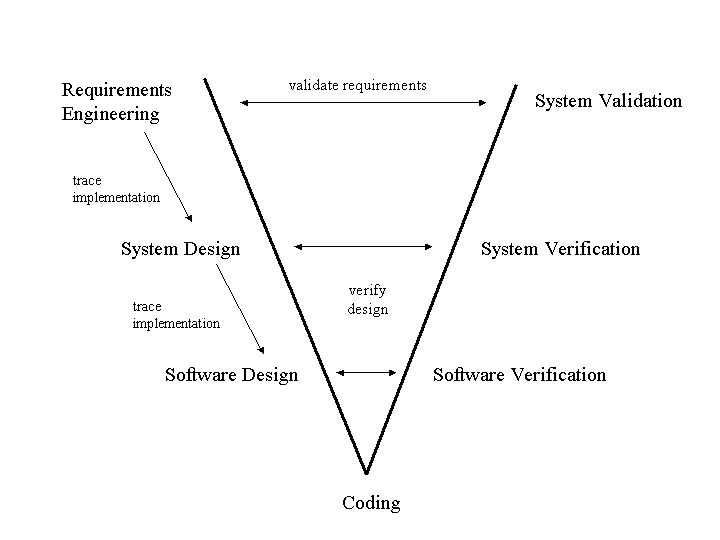 When there are a several choices of project managing lifecycles to choose from, which one suites you best.
Waterfall approach. Iterative cycles or spiral model. CMMI. Or the German V-Model.
The V-Model is an interesting concept from Germany. The left tail represents specifications; the right tail as the testing stream related to the specifications defined on the left. The V bottom represents the development stream.
Many projects fall short in the testing cycles. Either not enough or not enough of the right kind. The V-Model shows that testing needs to occur at all levels from the developers code to the business requirements.
Thursday, July 27
Informatica mashup

Morgan posts about the deal made between Informatica and Salesforce.com -- bringing DW and SaaS together, or as Morgan says, "data as a service". Users access Informatica tools in a services setting to migrate, synchronize and profile CRM data.
The Internet is disrupting a traditional BI toolset race. Google is in the news lately with Cognos and Google Maps doing BI-specific mashups. Soon more companies will realize that this can be a serious avenue for revenue growth. Let the entrepreneurial thinking kick into high gear.
For those, like me, who are new to "web mashups".
0 to 1 Terabyte in 60 seconds
This isn't your grandparents' harvest-gold kitchen appliance. They say it will give you "two orders of magnitude better price-performance" for analyzing large volumes of data. This is hardware with open source software that, when tightly integrated together, improves the performance when querying hundreds of terabytes of data.
Clarise makes the point that enterprises are not investing in new infrastructure and technology. So did Sun and Greenplum waste time & money on a product no one can buy?
Companies have growing volumes of data and the need for timely access to their information. I think we'll see more specialized appliances for the BI industry.
Clarise makes the point that enterprises are not investing in new infrastructure and technology. So did Sun and Greenplum waste time & money on a product no one can buy?
Companies have growing volumes of data and the need for timely access to their information. I think we'll see more specialized appliances for the BI industry.
Friday, July 21
BI affects so few
Putting BI in the hands of more users is our goal. Rob Ashe says only 20% of users access data through BI.
Now people are in search of better BI by integrating enterprise search capabilities with BI products.
Imagine typing in "Cases On Time" and getting results showing all the reports and OLAP cubes that match, the KPIs that are related to cases, and any user documentation on definitions and methodology.
You no longer need to remember where to look for information; you just need to know what you're looking for.
Now people are in search of better BI by integrating enterprise search capabilities with BI products.
Imagine typing in "Cases On Time" and getting results showing all the reports and OLAP cubes that match, the KPIs that are related to cases, and any user documentation on definitions and methodology.
You no longer need to remember where to look for information; you just need to know what you're looking for.
Wednesday, July 19
Rules for corporate reporting
 There are a flood of reports being proliferated throughout the organization. Who knows what they are used for. And now the "On-Time Cases" KPI means something different to each department.
Hearing this within your organization? This could be a problem from lack of best practices and governance.
The use of "Content Clusters" for corporate reporting, as Aloys Hosman writes, is an approach to clearly define your governance rules, which could save your organization from this mess.
This technique, among many things, lays out who is responsible for meta data within centrally managed data warehouses -- The Gatekeepers. It is less about ownership of the actual data; instead the discussion is focused on ownership of the metadata.
What I would add is the suggestion of not to detail out the entire governance rulebook at the beginning. See what works for your organization; monitor the process and make improvements. The key is to continuously improve so you don't have to create the perfect end-state at the start.
Subscribe to:
Posts (Atom)