Thursday, August 31

Choosing from the top 10


With 90+ performance management vendors out there having a list of the top 10 is invaluable. Craig Schiff's criteria identifies good companies with good offerings. For you making a choice for that "one right" product will be challenging to say the least.

There are two ways to find that one great product that your organization will thank you for finding (or not).

1) Ask someone who says they are an expert in the field. They should guide you through a process of elimination. They should interpret what your organization needs and keep you on the right path.

2) Dive in yourself. A high learning curve but you'll know the product offerings intimately. Be warned. Not all marketing material reflects the "truth" about the products or companies.

Either way the process is the same. Determine the criteria that are important to you. Price. Functionality. Vendor support. Do your research. Which will lead to more research. See a few vendor demonstrations and watch the salesperson courting ritual.

Making a choice is easy when you have hindsight. If you don't have it, use someone else's.

Friday, August 11

Ownership over governance

Knightsbridge released their Top 10 trends in BI. The Whitepaper is brief but they point out that the business is best suited to own and manage the organization's data. Afterall the business supplies the information and consumes the information; taking ownership over how the information is governed for BI only makes sense.

Knightsbridge's "6 key dimensions" for a governance program sound a bit technology and data quality focused. I may supplement them with The Gatekeeper approach and the business committment to taking ownership, especially of meta-data and proliferation of reports.

The ability to bring together multiple business units under Enterprise-level BI will require strong leadership. The business needs to assign leaders who have the authority and influence to navigate the political landscape.

When building a governance model, as Aloys points out, you want to start off with a 70%-right governance model, require committment from stakeholders, and paint a good looking end-state to help stakeholders through change.

Jim Wirth writes a more in-depth post about the top 5 Knightbridge trends.

Wednesday, August 9

Aussi rules for BI


Thanks to Alex Cook for this Austrailian Building Commission website that makes analysis of their performance measures available to the public. You can understand their business just from the intuitive nature of the website.

6 reasons why this is a great site for promoting successful BI:
  1. Users are the public so the drill down analysis needs to be dead simple.
  2. Defintions for each measure are explained clearly and concisely (and short).
  3. Seamless integration between the web user interface and BI tools.
  4. The analysis and reports are displayed using Web presentation best practices (BI vendors could learn here for their own Portal product offerings).
  5. Performance is relative; they compare to 16 headline measures.
  6. You don't know what BI tool is being used or even that you are using a BI tool.


Thursday, August 3

All-you-can-eat BI

All you need is a web browser. No infrastructure. No BI resources or specialists. Then you pay monthly for your transformed BI. How do you have BI without any resources or infrastructure? Doing this would definitely lower the barriers of entry for more SME's to get into BI.

Sharp Analytics offers to do just that - outsource your BI saving you from having BI infrastructure and BI specialists. They started as a niche BI company for marketing data. Now they are providing affordable, web-based, external BI for marketing, financial, utilities and retail.

Their "data as a service" approach lowers the financial burden and removes the need for technical skillsets when operating a BI system. Prepare for this model of BI to take hold and be used by more organizations. The reduced capital spending on initial infrastructure and toolset licenses may be a key driver for many.

Tuesday, August 1

Put the V in your project

When there are a several choices of project managing lifecycles to choose from, which one suites you best.

Waterfall approach. Iterative cycles or spiral model. CMMI. Or the German V-Model.

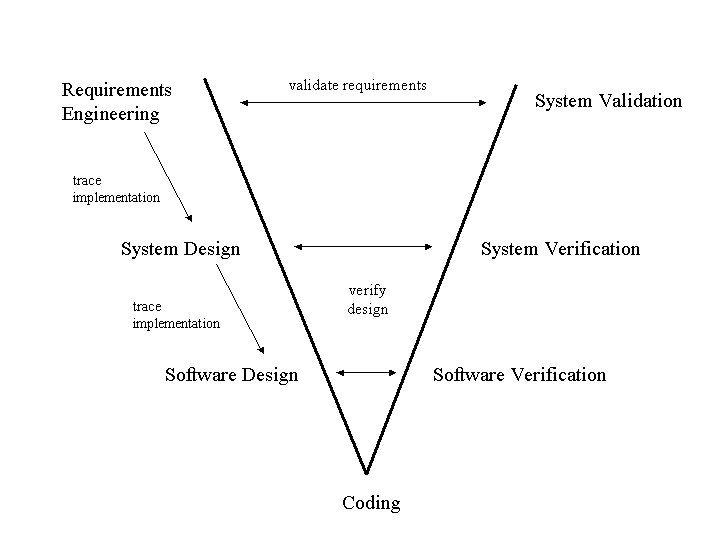
The V-Model is an interesting concept from Germany. The left tail represents specifications; the right tail as the testing stream related to the specifications defined on the left. The V bottom represents the development stream.

Many projects fall short in the testing cycles. Either not enough or not enough of the right kind. The V-Model shows that testing needs to occur at all levels from the developers code to the business requirements.

Thursday, July 27

Informatica mashup


Morgan posts about the deal made between Informatica and Salesforce.com -- bringing DW and SaaS together, or as Morgan says, "data as a service". Users access Informatica tools in a services setting to migrate, synchronize and profile CRM data.

The Internet is disrupting a traditional BI toolset race. Google is in the news lately with Cognos and Google Maps doing BI-specific mashups. Soon more companies will realize that this can be a serious avenue for revenue growth. Let the entrepreneurial thinking kick into high gear.

For those, like me, who are new to "web mashups".

0 to 1 Terabyte in 60 seconds

This isn't your grandparents' harvest-gold kitchen appliance. They say it will give you "two orders of magnitude better price-performance" for analyzing large volumes of data. This is hardware with open source software that, when tightly integrated together, improves the performance when querying hundreds of terabytes of data.

Clarise makes the point that enterprises are not investing in new infrastructure and technology. So did Sun and Greenplum waste time & money on a product no one can buy?

Companies have growing volumes of data and the need for timely access to their information. I think we'll see more specialized appliances for the BI industry.

Friday, July 21

BI affects so few

Putting BI in the hands of more users is our goal. Rob Ashe says only 20% of users access data through BI.

Now people are in search of better BI by integrating enterprise search capabilities with BI products.

Imagine typing in "Cases On Time" and getting results showing all the reports and OLAP cubes that match, the KPIs that are related to cases, and any user documentation on definitions and methodology.

You no longer need to remember where to look for information; you just need to know what you're looking for.

Wednesday, July 19

Rules for corporate reporting

There are a flood of reports being proliferated throughout the organization. Who knows what they are used for. And now the "On-Time Cases" KPI means something different to each department.

Hearing this within your organization? This could be a problem from lack of best practices and governance.

The use of "Content Clusters" for corporate reporting, as Aloys Hosman writes, is an approach to clearly define your governance rules, which could save your organization from this mess.

This technique, among many things, lays out who is responsible for meta data within centrally managed data warehouses -- The Gatekeepers. It is less about ownership of the actual data; instead the discussion is focused on ownership of the metadata.

What I would add is the suggestion of not to detail out the entire governance rulebook at the beginning. See what works for your organization; monitor the process and make improvements. The key is to continuously improve so you don't have to create the perfect end-state at the start.

Open source is validated by $8M

It is great to receive validation for what you work hard for. Venture capital funding to the tune of $13M over 8 months says there is a serious new competitor in town. This VC funding validates Pentaho's open source business model and potential to compete.

Interestingly, their product suite sounds similar to the existing BI vendors. "An integrated BI platform with OLAP, reporting, ETL, and data mining."

Tuesday, July 18

The idea of the Long-Tail


"Our culture and economy is increasingly shifting away from a focus on a relatively small number of mainstream products." -- Long Tail 101

1. Make everything available.
2. Help me find it.
Chris Anderson, The Long Tail

The ideas in Chris' new book will be talked about for years. His fresh perspective helps you understand the success stories of companies such as, Amazon, Google, Lego, RealNetworks, Netflix, and iTunes.

"As the costs of production and distribution fall, especially online, there is now less need to lump products and consumers into one-size-fits-all containers. In an era without the constraints of physical shelf space and other bottlenecks of distribution, narrowly-targeted goods and services can be as economically attractive as mainstream fare."

One. BI vendors may benefit from the Long Tail thinking. Focusing on the market of lots of items that sell a few units can be as profitable as a market of a few items that sell a lot of units. Today the aim is generic products with each installation using the same rainbow of product offerings. Assumes all customers have the same needs.

Two. BI can "make everything (ie. data) available" to the users. Bi does this well. But do we do a good job with the "help me find it"? Users can be lost in a sea of information BI makes available to them. A double-edged sword.

Apply various design approaches to increase user's usability of BI. Portal design. Free text search. Simplified look and feel. Personalized information.

Monday, July 17

Try an interactive report card

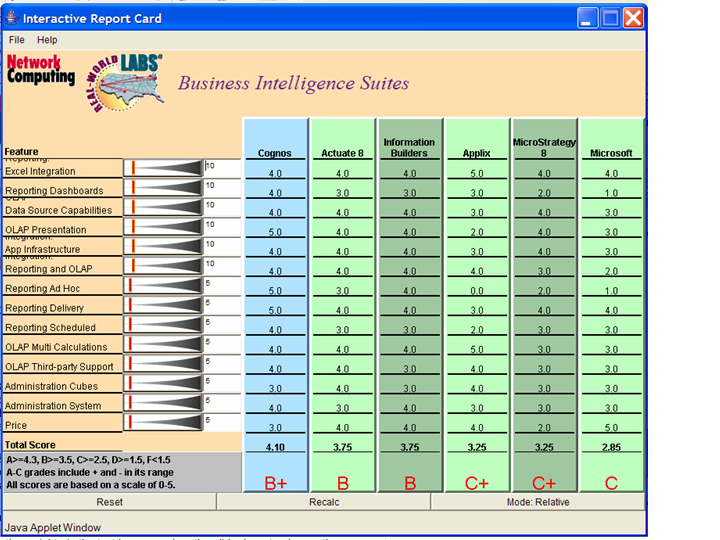
Why are BI suites compared and graded on someone else's criteria, by someone who doesn't know our company's needs? We should be able to rank BI product suites based on what is important to us. I don't need Language support. Or ad hoc reporting.

As Burger King would say, "giving it to you the way you want it."

Well, now you can. Try BI Pipeline's interactive report card (scroll down in the article to find the Java Report Card picture on the left and play with the numbers).

Monday, July 10

Squeezed from all sides

A generic strategy for most companies attempting to increase market share would be to innovate with leading edge services or products and jump ahead of the competition. Not Google. With Google Spreadsheets, they replicate an existing product that has been around for years, Excel, and shune the fact that it was created by the world's largest software maker, Microsoft.

You may say Google has too much time and money on their hands and their programmers are bored with building Internet search. But this could be one small strategic step with a leading edge vision.

One: I like this move because you shoot Microsoft in their sweet spot, Office products. Yes others have tried, but Google is on the software as a service (SaaS) model and they have a massively well-known brand backing them.

Two: They are now going after market share other than the cool search/consumer industry.

Now, here's where we get to BI.

Combine Google's SaaS model with it's recent partnerships with BI vendors, which is their public attempt to reach the corporate market (and they will). Together, and given time, you get what SalesForce.com, NetSuite, and ADP have done successfully in their industries for years but now in the BI space.

BI via software as a service.

Easy to use, Internet-based, BI paid by the month. No more unused licenses sitting on shelves. Increase or decrease users - only paying for what you need. You'd want configurable transformations and easy report building techniques.

Now before you discount the SaaS model or raise the privacy of information issues, consider this. Of all the companies that could leap frog the competition with leading edge innovation and technology, Google is a sure bet.

And it could be BI's time to take the next visionary leap.

Friday, July 7

9 things about BI from Google Trends

Google Trends can provide interesting results, as with Steve Rubel's 25 things in society's psyche post. So here are 9 BI industry trends.

1) Cognos and Business Objects are neck and neck, except Cognos is in the news more often.

2) There is double the popularity in DW than BI when in Pakistan, Indonesia, and Thailand.

3) And MIS jumps even higher in that area of the world.

4) Microsoft is still bigger than Oracle (both are searched more than IBM).

5) Almost no one has interest in ROLAP. Is OLAP now the winner?

6) Kimball is more popular than Inmon. Or is Kimball, the name, just more common.

7) Dominican Republic and Netherlands look for BPM more but overall BI searches are higher.

8) Informatica is untouchable, except when the giant SAS enters the picture.

9) Six Sigma out weighs Balance Scorecard by... well, alot. And India sure is looking for process improvement information.

And one from Steve's post...

Google is bigger than God?

Wednesday, June 28

Double dip marketing


You probably disapprove people taking a double dip with their chip in the party dip. But a similar technique is used by Microsoft and other software vendors. And Cognos is following suit. The marketing ploy generates a ton of money and word of mouth for the vendor. But are customers gaining any advantage with better quality products and services?

Certification programs and training classes. When software vendors promote training benchmarks to consulting and technology companies, who wins? And who's the real client?

Vendors like Microsoft, and now Cognos, double dip. Customers buy software (one dip). Consultants buy training (2nd dip). Consultants want to be reimbursed for this sunken cost. Customers buy consultants. Cognos gains marketing & word of mouth paid for by customers, employees and consultants (3rd dip?).

Granted vendors don't start there. They work hard to become successful to the point where people want their products (and are trained in their products). Shouldn't they reap the rewards of creating that base of customer/consultant demand? Just feed the pyramid and let others grow their business. Sounds like they have been reading Seth Godin's flipping the funnel ebook.

But customers benefit from higher skilled people, right? Sure, a skill benchmark is set. But set by the vendor - not exactly an independant assessment. And letters after your name look great on the resume (MSCE, PMP, MBA). But these certified people cost more to find, hire, and keep. And then certification alone doesn't reflect experience and quality of work.

The biggest vendors & products cost a premium. Highly skilled & certified people also come at a premium.

Pick the products that meet your specific business and technical needs. Think open source. Think young, eager BI companies nipping at the heals of the largest. Big doesn't always mean the best.


Quote bloggers live by, "Sorry this was so long. I didn't have time to make it shorter." -- Jefferson.

Saturday, June 24

1950's design

It may have been suggested to you as the latest and superior technique for building BI systems. The Iterative approach. Or RUP (Rational Unified Process). Or which ever cyclic methodology you follow, it isn't new.

Actually, these concepts have been around for decades. Plug into this 1950's YouTube video. The background music is classic. But the concepts they discuss using back then sound real familiar.

1. Define objectives.
2. Determine a theme boundary.
3. Many revisions and changes.
4. Sketch on paper then build 3D miniatures,
5. Then full-sized models.
6. Present for approval.

The question is, will we look back on our BI creations we build today and smile? Hopefully not the smile you get watching these 50's videos in fear that these styles will be retro and fashionable again. Gold-green shag carpet should be left in the past. As should Harvest-gold coloured kitchen appliances.

Can today's BI systems stand the test of time or are we producing our version of gold-green shag.

Here are other 1950's design videos for those reminiscing. One. Two.

Saturday, June 17

Other Best of Breed

To be fair to the "Other" category in the first survey, I've expanded that category. Those who voted for "Other" can now express their specific choice here. A quick click for those who picked "Other".

What people are saying about BI

When talking with people who "do" BI, I listen to what they think BI is. I hear: Analysis. MIS. OLAP. Reporting warehouse. Some people have just said, "we do Oracle BI", thinking the vendor/tools are what makes BI. And my favorite, "BI is BI" (assuming everyone knows what it means?).

So I used the Internet as a research tool and I can understand why there is confusion. Websites seem to have different definitions. MIS and BI are frequently used interchangeably but Wikipedia defines MIS differently than BI. Oracle's definition is tools focused, as expected. DM Review gives a decent business focused one. Which one do you grab onto?

It is true that the BI industry is getting more complex but the message being delivered is too. When talking with potential clients (internal or external) offer a consistent story that is authentic, entertaining, and enlightening. And offer it to the right audience.

If you're technically minded, deliver a clear message on the technology, its use, and limitations. Toolset/vendor specialists would do well with presenting an open minded view to gain an audience's trust. Delivering to the business may involve telling the advantages of performing better business decisions.

The message you deliver and to whom you deliver it are important.

Tuesday, June 13

Best-of-Breed winner


Many changes (improvements?) are happening in the BI space lately. Cognos has partnered with Google. Microsoft is embedding BI into their Office 2007 products. Oracle is the leading database vendor but losing ground.

But it's your perception of the BI products that is important. It is hard to beat word of mouth and see the results. Tell us if your IT group favours a specific vendor. Are users saying exemplary things about usability and features? Give your anonymous pick.

Sunday, June 4

BI on top of your agenda

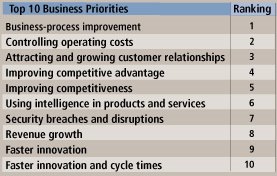
Gartner's latest report mentions that CIOs and IT groups need to "shift the focus from technology that serves a small segment of decision-makers to a much broader initiative that puts people and business objectives first".

Business priorities:

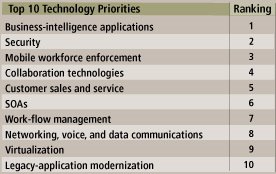
Top technology priority is also Business Intelligence:

Here's the full Optimize Magazine's article that references Gartner's survey on Executive priorities.

The article hits on some good points. "Put people and business objectives first." "BI will become increasing pervasive across the business." But their is some traditional, old school thinking, which, in the past, has proven ineffective for many organizations. A competency centre ("BICC"). A mix of business and IT people from the company.

The challenge for organizations new to BI projects is a competency centre usually delivers below the mark because there is no BI experience ("competency") to rely on. Even with experienced BI organizations, many times the group is stale for new ideas and relies on existing infrastructure and concepts. Fix the bugs. Copy & paste through the company. Not their fault, as they usually have their "real" job to go back to.

People need the innovation and creativity to move a project forward. Find that person who will sponsor the project and keep the business design forward thinking. To design and innovate may be their only job. If the project is large enough for a committee, typically a transient group of members, perhaps a position for a Design and Innovation specialist should be created.