There is much focus needed by different skilled people to create a new Business Intelligence system. Sometimes we get lost in the details ('forest through the trees'). More importantly, if your boat isn't set in the right direction from the beginning, you may end up sailing around for far too long and costing you more than it should.
I was reminded of this recently by Mark Fillmore from Actuate. Below is an article that talks about starting a Business Intelligence strategy. Obviously it's best to use strategic thinking from the start but even with an existing BI system, these thoughts can help refocus your BI plans.
Making Business Intelligence Work for You
Companies large and small can benefit from a well thought out business intelligence strategy, but developing that strategy can sometimes be more challenging than implementing a business intelligence program. To make sure that your company is getting the most out of your BI program, make sure that you define your goals and have a plan for the information you generate before you start collecting and analyzing data.
First Steps
Assess your current system of data collection. How you collect your data will make a difference in how complete your information is, which will in turn affect the results of your business intelligence program. Make sure that if you need historical data on your company or customers that you know where it is and how to access it. You’ll also need to take some time to understand your business needs and make a rough road map for how you would like your business to transform. Focus your attention on a few operational objective that can be achieved both short and long term.
Planning Your Strategy
Start with your vision of where you would like your company to be in 3 to 5 years. Pick specific goals that can be achieved with the assistance of a good business intelligence program. These goals should have measurable success rates or key performance indicators. You will use your key performance indicators (KPIs) as milestones for how close you are to accomplishing your goals. You can then set up your information infrastructure to collect the necessary data that can be analyzed and turned into information, which can be used to make effective decisions for your company.
In order to pick the most worthwhile goals, you must understand what the desired end result is. You will have to ask yourself what you will do with the business intelligence information your program generates once you have it. Otherwise, you will have a vast amount of information and no way to strategize around it. In companies without a comprehensive long-term plan, decision makers react to the information they get from their data without understanding the far-reaching consequences of their actions.
Another important thing to think about before you implement your program is what your options are once you have the information. Often companies have an idea of how they want to move forward and are looking to the business intelligence information generated by their BI program to support their current strategy. They soon learn that the information is not always in line with their current plan. Brainstorm all possible outcomes of your business intelligence program and think of ways that your company can improve based on the different results. You probably won’t be able to come up with every single possibility, but you will be prepared to think creatively when your BI program starts to generate useful information.
Lastly, remember why you are implementing this program. Business intelligence can be a huge asset to your business, but if you focus on the data and not on what the data can do for your company, your energy is misplaced. Before you become overwhelmed with data warehousing and data integration initiatives, take a step back and refocus on your company’s goals.
Showing posts with label Projects. Show all posts
Showing posts with label Projects. Show all posts
Thursday, December 18
Monday, November 17
Worst practices, who's got them

Learning from the mistakes of others is the way to go. No need to blaze a new path. It's all been done before. And BI has years of this "experience"; DW has "failures" from decades prior too.
This is backed up by Madan Sheina's article:
- 87% of BI projects in the UK don't live up to expectations.
- 25% of those projects are going over budget.
- Only 50% of end users were satisfied with the BI system
So what are you going to do about it?
You could read Peter Graham's posts about Kevin Quinn's "Worst Practices" whitepaper (saving you from signing up your email address).
Or read the following, which incorporates Kevin's ideas of worst practices but stays away from the marketing of a toolset vendor.
Let's start with the customers, or more specifically the business user. After all this is who BI is meant for. I figure adoption of BI tools is really low. I don't have a specific statistic but I find them difficult to use. People don't have the time to learn a new tool AND don't have the time to understand how to interpret the data.
Apply Tom's Spandex Rule: Just because you can wear spandex shorts, doesn't mean you should! (you know who you are)
Match what the people are asking for and reign in your project team. They can do it all given enough time. A zillion reports. Lots of dimensions, filters, and ranges. However, your BI system should provide what is being asked for. Stay away from the "it would be cool if..." until several years later when people want more.
Ah Excel.
Should you force people away from Excel to use this new BI system? Maybe. Maybe not. Some say Excel is preferred because of it's familiarity and simplicity. Well I think the majority of people who have used Excel don't know how to create a pivot table or know why they should use one.
So in my opinion, Excel is used because it is quick! No involvement from IT. They can do it themselves until it works for them. Typically they are looking to solve a business problem, they just need the evidence.
BI just made their lives a whole lot more complicated. Now they need to write a request for what they want. Then when they get it, it's in this strange BI tool. At which point they copy it into Excel and continue on. Granted they probably have more data than before and cleaner data for sure.
Which brings us to the data warehouse. Yes, a storage area for internal data. What about data external to the organization? Many would caution the use of external sources because of inconsistencies, not having control of the quality, difficulties aligning with the data warehouse, etc.
Let me ask you, "who is the biggest data provider in the world?" Google. What do they do differently? They allow the consumer to determine whether the data is relevant and give them access to everything. They've empowered people with information access.
We need to let it go. The days of the data warehouse or BI team or IT department controlling all the data should come to an end. The business should get access to information they want and need, internal or external, in a BI tool or Excel and when they want/need it.
For instance, Chevron has 200,000 employees worldwide and uses MSFT BI to deliver specific, targeted information to many of them. Starbucks uses Microstrategy to publish in-store metrics to every store manager. Boeing uses MSFT BI to provide manufacturing performance metrics for managers.
These are all extremely large organizations and yet they aren't pushing out tons of cubes, reports, and dashboards. BI is not a central focus for their employees but it does give them targeted information specific to their needs.
Remember Tom's Spandex Rule. Just because they could, doesn't mean they did.
Thursday, July 10
BI has it all wrong?
The BI market is showing a flurry of innovation and new companies over the last year or so. Usually stale industries or high customer pain forces new ideas to come to fruition. Reading blogs of people who actually work on projects or companies that do BI, you can hear some of this pain.
So what can be done to make the experience for customers better? Well thanks Rick Rogers for the link to The Future of BI, by Tom Gonzalez. Some excellent insights and he may be onto something with his ideas for dashboards. May not solve all the problems, but every bit helps.
So what can be done to make the experience for customers better? Well thanks Rick Rogers for the link to The Future of BI, by Tom Gonzalez. Some excellent insights and he may be onto something with his ideas for dashboards. May not solve all the problems, but every bit helps.
Friday, January 4
Who's better, business or IT

I recently consulted on a large government project where the project sponsor was the CIO. There were only two people above him before you step into the land of 'professional' politicians. This CIO was savvy, smart, and needed to build buy-in from multiple stakeholders (Chiefs of Police... a difficult breed comfortable with conflict) to make this $100M project a success. You may ask how one could not be successful with that kind of cash on the table... but it happens... a lot.
I can think of failed project examples. Specifically I'm thinking of 3 projects in the last 6 years done by large consulting firms (ie. the IBMs, EDS', Accenture's of the world), where failure cost tens of millions of dollars with little or no results. Much of this was your taxpayer money hard at work by the way.
So what makes an unsuccessful project?
Some potential culprits are: technology issues, budget constraints, timeline constraints, user adoption and leadership can contribute to failure. However, leadership stands out the most for me. A leader or project sponsor can make or break the project. They give direction, remove political roadblocks, manage the money... and significant issues escalate to them for final decision.
They have lots to answer for. However let's divide sponsors/leaders into two groups: IT and business. IT sponsors may be the CIO or IT department head. Business sponsors may be CEO, CFO, or VP of a line of business. BUT...
Who makes a better project sponsor and hence best to run a BI project?
(I'm pro-business for this open debate expecting you bloggers and readers out there to provide sharp contrasts and opinionated rebuttles... and support, of course. [Bell ding to begin the round.])
Let's begin with the fact that organizations typically don't have the CIO at the decision-making table - sad but true (oops, I'm pro-business). Okay don't you think this can hinder success if the IT sponsor does not have the backing of the CxO's office? You betcha. Because, let's remember, it's the business who holds the purse strings. And the golden rule is - those with the money, make the rules.
But even without making the rules, business knows what they want and need from BI - simply gather the user & information requirements and ensure IT makes the technology happen. The misconception that IT makes is "if we build it, they will come" -- the value would be so obvious users would clamor to use the BI system. Not true without the business showing IT what they want.
So is it obvious that business sponsors should lead BI projects, especially since BI is for the business? And where do CIO's think they can do a better job? (By the way, the police project I mention above is in progress, so I'll let you know how it goes for the CIO.)

I can think of failed project examples. Specifically I'm thinking of 3 projects in the last 6 years done by large consulting firms (ie. the IBMs, EDS', Accenture's of the world), where failure cost tens of millions of dollars with little or no results. Much of this was your taxpayer money hard at work by the way.
So what makes an unsuccessful project?
Some potential culprits are: technology issues, budget constraints, timeline constraints, user adoption and leadership can contribute to failure. However, leadership stands out the most for me. A leader or project sponsor can make or break the project. They give direction, remove political roadblocks, manage the money... and significant issues escalate to them for final decision.
They have lots to answer for. However let's divide sponsors/leaders into two groups: IT and business. IT sponsors may be the CIO or IT department head. Business sponsors may be CEO, CFO, or VP of a line of business. BUT...
Who makes a better project sponsor and hence best to run a BI project?
(I'm pro-business for this open debate expecting you bloggers and readers out there to provide sharp contrasts and opinionated rebuttles... and support, of course. [Bell ding to begin the round.])
Let's begin with the fact that organizations typically don't have the CIO at the decision-making table - sad but true (oops, I'm pro-business). Okay don't you think this can hinder success if the IT sponsor does not have the backing of the CxO's office? You betcha. Because, let's remember, it's the business who holds the purse strings. And the golden rule is - those with the money, make the rules.
But even without making the rules, business knows what they want and need from BI - simply gather the user & information requirements and ensure IT makes the technology happen. The misconception that IT makes is "if we build it, they will come" -- the value would be so obvious users would clamor to use the BI system. Not true without the business showing IT what they want.
So is it obvious that business sponsors should lead BI projects, especially since BI is for the business? And where do CIO's think they can do a better job? (By the way, the police project I mention above is in progress, so I'll let you know how it goes for the CIO.)
Tuesday, September 4
The role of business vs IT
 Business Intelligence crosses both the business and IT boundaries -- unfortunately for some it is seen strictly as an IT initiative. Frank Buytendijk's post makes an excellent point: "you are not delivering 20 reports", you are helping "business users make really good decisions".
Check out Frank's blog site (he is the VP of Corporate Strategy at Hyperion/Oracle), *new* since Oracle's acquisition of Hyperion.
He goes on to say how the business has bargained (actually leveraged) themselves to the point of 'no responsibility' for initiatives that involve IT support. IT writes the business case for a system to improve the business. IT is responsible for project deadlines and budgets. And who has to live with the results?
The Business.
So wouldn't you want more influence, control, and input into something you have to live with for years, maybe a decade? When I want a vehicle to drive, I don't ask the mechanic to find one for me. Although I'm sure the car would be great under the hood. Because maybe I want my unique style, colour, prestige, the right growl to the engine. Aesthetics. Generally not a mechanic's forte.
So why rely on IT to be responsible for your system's initiative.
Saying that, IT brings much to the table. Such as, people who know what is technically possible, IT project managers, and support staff to keep the lights on once it is built. What they don't bring to the table, which you can, is this:
- Business knowledge and how the business really works.
- What information is important to you.
- How you want to measure your business.
- How a system should improve your processes.
- How a system impacts the bottom line.
- Senior business executive sponsorship.
Tuesday, July 31
Wake up call for Air Canada
How many times do you need to hear something before it sinks in and you take action. When people ask for it - respond. Air Canada did, partially. As a decentralized organization using Excel spreadsheets for reporting, you can imagine how effective they were back in 2002. However their initial challenge wasn't building a BI centre of excellence, envisioning a one shared truth, or a well-thought-out technical architecture.
It was making BI easy and useful for the novice user (rather than just the power-users).
Briony Smith wrote an article in IT World Canada about Air Canada using IBI WebFocus because of the cheaper price point, high usability, and visualization tools.
But this is not about tools. Less than 20% of people in an organization use BI. Why could that be. Take away the bad implementations, insufficient toolset functionality, and untrained developers & project mgrs. What you're left with is approach and understanding the business problem.
Briony's article speaks of business intelligence competency centres as a way to bring together IT and business people to "break down the walls". Air Canada resisted this centralized approach (and I think missing out on improved collaboration and communication).
So many times have I seen projects boil down to technology, architecture and design. Important yes. Technologist focused yes. Incomplete picture yes.
The C-level execs are taking back control of IT decisions. You can see this with more and more IT professionals being left out of the decision-making loop. This makes delivering successful BI projects a challenge, no? Creating a competency centre (i.e. committee) in and of itself doesn't make a success.
IT professionals are left out of decisions because the needs of the business are not being met from IT projects. Having IT at a decision-making meeting is perceived as having little value. Knowing architecture, dimensions and toolsets is not big value to the final decision.
So here are 3.5 ways to add value and get invited back into that meeting:
As a side note, Westjet (Air Canada's main competitor for readers outside of Canada) has a large BI centre and also moved away from a plethora of Excel spreadsheets. The approach Westjet took was taking the BI technologists around to watch employees interact with customers and do their jobs with Excel. Hands-on requirements gathering.
It was making BI easy and useful for the novice user (rather than just the power-users).
Briony Smith wrote an article in IT World Canada about Air Canada using IBI WebFocus because of the cheaper price point, high usability, and visualization tools.
But this is not about tools. Less than 20% of people in an organization use BI. Why could that be. Take away the bad implementations, insufficient toolset functionality, and untrained developers & project mgrs. What you're left with is approach and understanding the business problem.
Briony's article speaks of business intelligence competency centres as a way to bring together IT and business people to "break down the walls". Air Canada resisted this centralized approach (and I think missing out on improved collaboration and communication).
So many times have I seen projects boil down to technology, architecture and design. Important yes. Technologist focused yes. Incomplete picture yes.
The C-level execs are taking back control of IT decisions. You can see this with more and more IT professionals being left out of the decision-making loop. This makes delivering successful BI projects a challenge, no? Creating a competency centre (i.e. committee) in and of itself doesn't make a success.
IT professionals are left out of decisions because the needs of the business are not being met from IT projects. Having IT at a decision-making meeting is perceived as having little value. Knowing architecture, dimensions and toolsets is not big value to the final decision.
So here are 3.5 ways to add value and get invited back into that meeting:
- 1. Be more than just technologists. I'm not saying go out and get an MBA, but at least speak their language. Save the tech talk for your friends. Slowly changing dimensions really don't matter.
- 2. Provide value by meeting business people's needs. BI is for the business, first and foremost. Understand their business problems from their perspective - not the vendors.
- 3. Solve their business problems with an easy to use result. They shouldn't need the same toolset training as you have to extract the results they need.
- 3.5. Make decisions based on what's best for the organization and employees. The vendor your friend works for is probably not the best choice.
As a side note, Westjet (Air Canada's main competitor for readers outside of Canada) has a large BI centre and also moved away from a plethora of Excel spreadsheets. The approach Westjet took was taking the BI technologists around to watch employees interact with customers and do their jobs with Excel. Hands-on requirements gathering.
Saturday, April 28
Sybase late to the party

Pretty much every vendor has a tool to move information into a data warehouse - an ETL (extract, transform, load) tool. More recently with Oracle and Sunopsis, they have a competing offering with E-L-T tools. And some vendors offer ETLT, like Microsoft's SSIS.
So isn't Sybase late to this party by announcing they are adding to their suite an ETL tool? Unfortunately it does look similar to Oracle's approach of an embedded ETL tool within their database. I'm sure there are technical differences and I'm sure some would say the Sybase IQ ETL tool is separate from and can be used independantly from their Sybase ASE database.
But what's the point?!?
The question if I were a company or IT department looking for ETL is, "if I don't have the Sybase database, why would I look at Sybase ETL tools?" Oracle has a similar problem. I have never heard of Oracle's ETL tools (or any Oracle BI tools) being used with anything but Oracle databases.
It's one of the major drawbacks of having an integrated database with BI/DW tools. Yes, there are advantages to being tightly coupled but aren't they just technical. Are there "true" advantages for companies having an all Oracle or Sybase or Microsoft shop?
Their mantra: the synergy of our single vendor offering is in the overall value, where the value is more than the sum of the pieces (one plus one is three).
But what about doing a 'mix and match' by taking the best tools from the best vendors? Our society wants choice, your company should also have choice. Choosing the tools that meet your company's critieria, such as price, functionality, and ease of use, would reduce your risks of relying on one vendor.
The moral: Purchase tools based on your specific meaningful criteria and don't be caught up with the 'we have that tool as well' sales game.
At least having a choice will ensure you get what you asked for. And you never know, that may be from one vendor afterall.
Wednesday, April 11
BI Success Checklist
Excellent post by Timo Elliott about the five fatal flaws of BI. I would use these for any and every BI project. Are you starting BI internally and what to be successful? Use Timo's list as your guide.
Because I work on different projects for various organizations, having a checklist like Timo's would help me focus my efforts in the direction of success each and every time.
Because I work on different projects for various organizations, having a checklist like Timo's would help me focus my efforts in the direction of success each and every time.
Saturday, February 24
Integrated performance management
Integrating the various components of your corporate performance management initiative is going to be challenging. But sometimes the best organizational improvements you make are the most difficult. Increase the effectiveness by going beyond just measuring past performance for the sake of measurement -- integrate individual compensation, recognition and rewards into the overall process.
This CPM blog explains it nicely. And thanks to Frank Buytendijk, Hyperion's VP of Corporate Strategy, for his performance management blog.
So why link people to the high level performance measures?
One word -- effective-motivated-employees!
Having key performance indicators is a start but typically are abstract to the point where the employee doesn't understand where their contribution to the company fits into the performance strategy. The hard part is taking the process from a strategic level to an operational level and clearly linking individual performance to the overall corporate goals.
But once there, you will realize the benefits of your hard work!
Here's a YouTube clip about combat readiness for an underperforming navel vessel. And how the captain used communication to improve productivity.
Now go and integrate individual performance to the overall corporate strategy so employees understand why they are spending most of their day at work!
This CPM blog explains it nicely. And thanks to Frank Buytendijk, Hyperion's VP of Corporate Strategy, for his performance management blog.
So why link people to the high level performance measures?
One word -- effective-motivated-employees!
Having key performance indicators is a start but typically are abstract to the point where the employee doesn't understand where their contribution to the company fits into the performance strategy. The hard part is taking the process from a strategic level to an operational level and clearly linking individual performance to the overall corporate goals.
But once there, you will realize the benefits of your hard work!
Here's a YouTube clip about combat readiness for an underperforming navel vessel. And how the captain used communication to improve productivity.
Now go and integrate individual performance to the overall corporate strategy so employees understand why they are spending most of their day at work!
Saturday, January 6
Building planes in the sky

So you have built a mature Business Intelligence offering that has supported your business for years. Everything is running relatively smoothly. Users are getting accurate information in a timely manner. You feel confident that you can reap the benefits of your hard work.
Or can you.
There is more to be done (there always is) but how do you accomplish this while your production system is being used by all those users?
Well here's how planes are built while in flight.
There is usually more that can/should be done. Whether it involves upgrading the software to the latest Web 2.0, content sharing, self sufficient reporting products. Or supplementing your implementation with executive reporting, financial planning models, or following up with users for their latest analytical needs.
But the question is how do you make this happen when you have a production system running. You want to keep the lights on for those using it. No downtime - 24x7x365. Maybe it would help by hearing from the different roles in a project (mostly in jest).
Project Managers: Determine the risks of upgrading, find the critical path, and add a contingency to the estimates. We can do this if we add more resources to the project plan.
Technologists: Use more hardware/software for multiple environments and after doing Agile development just switch all users to the new system. Simple.
Users: Um, we like what we have. What is this upgrade going to give us again?
Friday, August 11
Ownership over governance
Knightsbridge released their Top 10 trends in BI. The Whitepaper is brief but they point out that the business is best suited to own and manage the organization's data. Afterall the business supplies the information and consumes the information; taking ownership over how the information is governed for BI only makes sense.
Knightsbridge's "6 key dimensions" for a governance program sound a bit technology and data quality focused. I may supplement them with The Gatekeeper approach and the business committment to taking ownership, especially of meta-data and proliferation of reports.
The ability to bring together multiple business units under Enterprise-level BI will require strong leadership. The business needs to assign leaders who have the authority and influence to navigate the political landscape.
When building a governance model, as Aloys points out, you want to start off with a 70%-right governance model, require committment from stakeholders, and paint a good looking end-state to help stakeholders through change.
Jim Wirth writes a more in-depth post about the top 5 Knightbridge trends.
Knightsbridge's "6 key dimensions" for a governance program sound a bit technology and data quality focused. I may supplement them with The Gatekeeper approach and the business committment to taking ownership, especially of meta-data and proliferation of reports.
The ability to bring together multiple business units under Enterprise-level BI will require strong leadership. The business needs to assign leaders who have the authority and influence to navigate the political landscape.
When building a governance model, as Aloys points out, you want to start off with a 70%-right governance model, require committment from stakeholders, and paint a good looking end-state to help stakeholders through change.
Jim Wirth writes a more in-depth post about the top 5 Knightbridge trends.
Tuesday, August 1
Put the V in your project
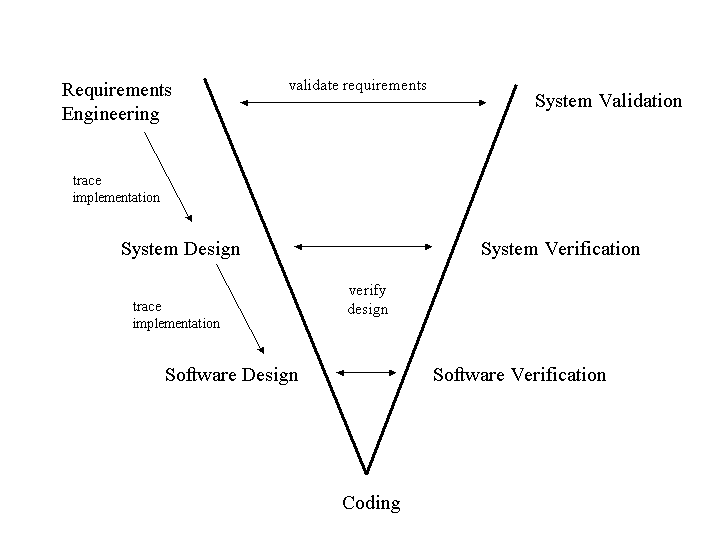 When there are a several choices of project managing lifecycles to choose from, which one suites you best.
Waterfall approach. Iterative cycles or spiral model. CMMI. Or the German V-Model.
The V-Model is an interesting concept from Germany. The left tail represents specifications; the right tail as the testing stream related to the specifications defined on the left. The V bottom represents the development stream.
Many projects fall short in the testing cycles. Either not enough or not enough of the right kind. The V-Model shows that testing needs to occur at all levels from the developers code to the business requirements.
Wednesday, July 19
Rules for corporate reporting
 There are a flood of reports being proliferated throughout the organization. Who knows what they are used for. And now the "On-Time Cases" KPI means something different to each department.
Hearing this within your organization? This could be a problem from lack of best practices and governance.
The use of "Content Clusters" for corporate reporting, as Aloys Hosman writes, is an approach to clearly define your governance rules, which could save your organization from this mess.
This technique, among many things, lays out who is responsible for meta data within centrally managed data warehouses -- The Gatekeepers. It is less about ownership of the actual data; instead the discussion is focused on ownership of the metadata.
What I would add is the suggestion of not to detail out the entire governance rulebook at the beginning. See what works for your organization; monitor the process and make improvements. The key is to continuously improve so you don't have to create the perfect end-state at the start.
Saturday, June 24
1950's design
It may have been suggested to you as the latest and superior technique for building BI systems. The Iterative approach. Or RUP (Rational Unified Process). Or which ever cyclic methodology you follow, it isn't new.
Actually, these concepts have been around for decades. Plug into this 1950's YouTube video. The background music is classic. But the concepts they discuss using back then sound real familiar.
1. Define objectives.
2. Determine a theme boundary.
3. Many revisions and changes.
4. Sketch on paper then build 3D miniatures,
5. Then full-sized models.
6. Present for approval.
The question is, will we look back on our BI creations we build today and smile? Hopefully not the smile you get watching these 50's videos in fear that these styles will be retro and fashionable again. Gold-green shag carpet should be left in the past. As should Harvest-gold coloured kitchen appliances.
Can today's BI systems stand the test of time or are we producing our version of gold-green shag.
Here are other 1950's design videos for those reminiscing. One. Two.
Actually, these concepts have been around for decades. Plug into this 1950's YouTube video. The background music is classic. But the concepts they discuss using back then sound real familiar.
1. Define objectives.
2. Determine a theme boundary.
3. Many revisions and changes.
4. Sketch on paper then build 3D miniatures,
5. Then full-sized models.
6. Present for approval.
The question is, will we look back on our BI creations we build today and smile? Hopefully not the smile you get watching these 50's videos in fear that these styles will be retro and fashionable again. Gold-green shag carpet should be left in the past. As should Harvest-gold coloured kitchen appliances.
Can today's BI systems stand the test of time or are we producing our version of gold-green shag.
Here are other 1950's design videos for those reminiscing. One. Two.
Sunday, June 4
BI on top of your agenda
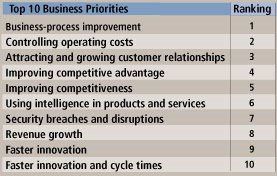
Gartner's latest report mentions that CIOs and IT groups need to "shift the focus from technology that serves a small segment of decision-makers to a much broader initiative that puts people and business objectives first".
Business priorities:
Top technology priority is also Business Intelligence:
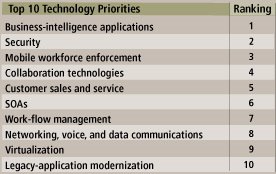
Here's the full Optimize Magazine's article that references Gartner's survey on Executive priorities.
The article hits on some good points. "Put people and business objectives first." "BI will become increasing pervasive across the business." But their is some traditional, old school thinking, which, in the past, has proven ineffective for many organizations. A competency centre ("BICC"). A mix of business and IT people from the company.
The challenge for organizations new to BI projects is a competency centre usually delivers below the mark because there is no BI experience ("competency") to rely on. Even with experienced BI organizations, many times the group is stale for new ideas and relies on existing infrastructure and concepts. Fix the bugs. Copy & paste through the company. Not their fault, as they usually have their "real" job to go back to.
People need the innovation and creativity to move a project forward. Find that person who will sponsor the project and keep the business design forward thinking. To design and innovate may be their only job. If the project is large enough for a committee, typically a transient group of members, perhaps a position for a Design and Innovation specialist should be created.
Business priorities:
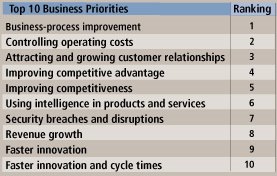
Top technology priority is also Business Intelligence:
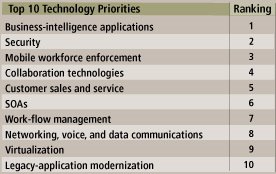
Here's the full Optimize Magazine's article that references Gartner's survey on Executive priorities.
The article hits on some good points. "Put people and business objectives first." "BI will become increasing pervasive across the business." But their is some traditional, old school thinking, which, in the past, has proven ineffective for many organizations. A competency centre ("BICC"). A mix of business and IT people from the company.
The challenge for organizations new to BI projects is a competency centre usually delivers below the mark because there is no BI experience ("competency") to rely on. Even with experienced BI organizations, many times the group is stale for new ideas and relies on existing infrastructure and concepts. Fix the bugs. Copy & paste through the company. Not their fault, as they usually have their "real" job to go back to.
People need the innovation and creativity to move a project forward. Find that person who will sponsor the project and keep the business design forward thinking. To design and innovate may be their only job. If the project is large enough for a committee, typically a transient group of members, perhaps a position for a Design and Innovation specialist should be created.
Friday, June 2
Until you see what is done
The design of BI is complicated. Not the technology architecture (although tough, just not what this post is about) but the innovative design that will meet the business needs. What should it look like on the screen? What is the best way to do this? Many times business people don't know what they want until they see it. Brian Sooy's Skeet shooting design woes tells the story.
The difficulty is how to work with the ambiguity without blowing your budget or spending more time & money than necessary. Or worse, not meeting the needs of your audience. ie. No one uses it.
Brian's definition of design:
So what do you do? Who should or could do the design? True business people and IT people think differently. It's why they are in their field of expertise. In some cases, organizations doing BI have instituted a middle-man to coordinate between business and IT. Unfortunately, these positions are dumped on from both sides and rarely carry the authority to make decisions.
An interior designer for building a house isn't there to facilitate between the contractor and the owner. The designer interepts the owner's wants & needs into the language the contractor will understand; but knows the contraints the contractor is restricted by. If you've even looked for a house, you will have seen someone's self-designed interior. The wall colours seemingly picked randomly. The furniture from Ikea and the local-artistic-funky furniture company. The carpet from the 20's. No vision, just ideas from magazine flipping.
For your BI project, find someone who can see both sides - business vision and the technology constraints. It's not important that they know 'how' it will get built in the end. Let them be creative and innovative with the authority to make design choices.
The difficulty is how to work with the ambiguity without blowing your budget or spending more time & money than necessary. Or worse, not meeting the needs of your audience. ie. No one uses it.
Brian's definition of design:
Design consists of creating things for clients who may not know what they want, until they see what you've done, then they know exactly what they want, but it's not what you did.
So what do you do? Who should or could do the design? True business people and IT people think differently. It's why they are in their field of expertise. In some cases, organizations doing BI have instituted a middle-man to coordinate between business and IT. Unfortunately, these positions are dumped on from both sides and rarely carry the authority to make decisions.
An interior designer for building a house isn't there to facilitate between the contractor and the owner. The designer interepts the owner's wants & needs into the language the contractor will understand; but knows the contraints the contractor is restricted by. If you've even looked for a house, you will have seen someone's self-designed interior. The wall colours seemingly picked randomly. The furniture from Ikea and the local-artistic-funky furniture company. The carpet from the 20's. No vision, just ideas from magazine flipping.
For your BI project, find someone who can see both sides - business vision and the technology constraints. It's not important that they know 'how' it will get built in the end. Let them be creative and innovative with the authority to make design choices.
Friday, May 26
Look for a different approach
Seth Godin has a way of clearly showing the way through change. When starting a new BI initiative or building on your existing BI offering, improvements on the status quo can be helpful, but looking for what makes your project different will engage people. From the business sponsors to the IT group.
Excitement for BI can be seen in most organizations. Momentum to move a project forward is usually lacking. Or how to create and maintain that momentum is.
Find ways to move the next step closer to the vision. There is an unending list of issues that seem to need to be resolved before proceeding. Don't resolve them. Re-juggle tasks. Re-prioritize. Use a mini-project for the team to gain confidence and answer questions.
What ever it takes.
What visible results can be done this week? Can we mock up screens or create databases? Can we build relationships to lower any political roadblocks?
Here's a true story about a company wanting BI. It has been months, if not a year, since a couple internal people began educating and pushing for BI. The value to the company was very apparent. Time savings. Accuracy of information. Tons of data but no way of analyzing (or even accessing it!).
The next step was to involve someone from IT. But then IT raised so many issues and concerns that many felt it was not feasible. In my experience, IT usually raises many issues because they are the ones that need to live with doing the heavy lifting. But they are all, yes all, solvable.
They are now stuck waiting for IT to research and resolve the technical issues. Stalled, spending time & money without producing visible results. Many do it this way.
Or you could think "different" and present something each week that engages the business-side. BI is for the business after all. Write a business case or value proposition. No technical infrastructure? Use free or trial version software and create something relevant on your computer. Show your boss. Your boss' boss.
There's always a way to move forward.
Excitement for BI can be seen in most organizations. Momentum to move a project forward is usually lacking. Or how to create and maintain that momentum is.
Find ways to move the next step closer to the vision. There is an unending list of issues that seem to need to be resolved before proceeding. Don't resolve them. Re-juggle tasks. Re-prioritize. Use a mini-project for the team to gain confidence and answer questions.
What ever it takes.
What visible results can be done this week? Can we mock up screens or create databases? Can we build relationships to lower any political roadblocks?
Here's a true story about a company wanting BI. It has been months, if not a year, since a couple internal people began educating and pushing for BI. The value to the company was very apparent. Time savings. Accuracy of information. Tons of data but no way of analyzing (or even accessing it!).
The next step was to involve someone from IT. But then IT raised so many issues and concerns that many felt it was not feasible. In my experience, IT usually raises many issues because they are the ones that need to live with doing the heavy lifting. But they are all, yes all, solvable.
They are now stuck waiting for IT to research and resolve the technical issues. Stalled, spending time & money without producing visible results. Many do it this way.
Or you could think "different" and present something each week that engages the business-side. BI is for the business after all. Write a business case or value proposition. No technical infrastructure? Use free or trial version software and create something relevant on your computer. Show your boss. Your boss' boss.
There's always a way to move forward.
Friday, May 19
Leadership, on or off the bus
Organizations new to BI are typically excited and see the value of BI. So why do they hold themselves back from getting started? A recent engagement with a large organization has left me wondering if they are willing to do what it takes to benefit themselves. Realistically, I expect some resistence at the beginning. There's change involved. Many unanswered questions. Budget approvals.
But once you've started down the path and people are ramping up, either get on the bus and help steer it towards success. Or get out of the way.
Here's where I'm coming from: (names altered to protect the innocent)
Executive levels gave all approvals necessary for the externally hired BI team to begin. The business sponsor, Stan, gave the nod to start with his source system. Access to data was needed and it took 4 days before Stan talked to an IT guy, Paul.
Another 4 days before the team finds out that Paul's manager didn't have authority to give access and didn't say anything. So we find the proper manager, Lara. But she cannot authorize without Stan's approval. Another 5 days later. Stan gives approval to Lara and Lara sends an email to, yes, Paul.
Over 13 days after the project kick-off the BI team starts. This is shaping up to be one drawn out project.
But once you've started down the path and people are ramping up, either get on the bus and help steer it towards success. Or get out of the way.
Here's where I'm coming from: (names altered to protect the innocent)
Executive levels gave all approvals necessary for the externally hired BI team to begin. The business sponsor, Stan, gave the nod to start with his source system. Access to data was needed and it took 4 days before Stan talked to an IT guy, Paul.
Another 4 days before the team finds out that Paul's manager didn't have authority to give access and didn't say anything. So we find the proper manager, Lara. But she cannot authorize without Stan's approval. Another 5 days later. Stan gives approval to Lara and Lara sends an email to, yes, Paul.
Over 13 days after the project kick-off the BI team starts. This is shaping up to be one drawn out project.
Saturday, May 13
Success is a series of singles and doubles
Hitting the home run in BI (successfully delivering your BI initiative) is similar to Seth Godin's baseball analogy for marketing success. Baseball games are won by hitting singles and doubles to load the bases. Then you hit a homerun and you've maximized the effort you spent loading those bases. Then. Do it all over again.
Successful BI initiatives utilize a similar approach. "Think big; act in small, iterative cycles". Hitting the home run in the first inning, on the surface, can be sexy and rally the troupes. But in BI, this holds a high risk of your project not even getting off the ground.
A good approach is focusing on educating yourself and your company or team (you can start by using the BI for Business People lens) on what is important to you, what should happen initially, and what the goal could be for your organization. And not that you need to make it a concensus building exercise (unless your organization has that type of culture). And find expertise from people who have "been there and done that". Learn from them. Nothing can replace proven experience.
Three quick ones to get started:
Determine if BI can solve the problem. This should be a quick step using someone who has some depth of BI experience. Watch that you don't fall into one of two ruts: "as a hammer, everything looks like a nail" and at the opposite side of the spectrum, "analysis-paralysis".
Which team or business unit can put time towards supporting the project. This effort from business users ensures that the technical team doesn't guess and delivers value to the business. After all, BI is for the business. This committment of bodies will also demonstrate who is willing and able to move forward. No committment? Not a high priority.
Have you seen what the toolsets can do? Usually I would hesitate to suggest bringing in vendors to pitch their products. Most will say 'yes, our products can do everything you want'. Talk to an unbiased consultant (toolset agnostic). Talk to companies who have done BI. Attend webinars.
Education can be a powerful ally; but make sure you're executing as well.
Successful BI initiatives utilize a similar approach. "Think big; act in small, iterative cycles". Hitting the home run in the first inning, on the surface, can be sexy and rally the troupes. But in BI, this holds a high risk of your project not even getting off the ground.
A good approach is focusing on educating yourself and your company or team (you can start by using the BI for Business People lens) on what is important to you, what should happen initially, and what the goal could be for your organization. And not that you need to make it a concensus building exercise (unless your organization has that type of culture). And find expertise from people who have "been there and done that". Learn from them. Nothing can replace proven experience.
Three quick ones to get started:
Determine if BI can solve the problem. This should be a quick step using someone who has some depth of BI experience. Watch that you don't fall into one of two ruts: "as a hammer, everything looks like a nail" and at the opposite side of the spectrum, "analysis-paralysis".
Which team or business unit can put time towards supporting the project. This effort from business users ensures that the technical team doesn't guess and delivers value to the business. After all, BI is for the business. This committment of bodies will also demonstrate who is willing and able to move forward. No committment? Not a high priority.
Have you seen what the toolsets can do? Usually I would hesitate to suggest bringing in vendors to pitch their products. Most will say 'yes, our products can do everything you want'. Talk to an unbiased consultant (toolset agnostic). Talk to companies who have done BI. Attend webinars.
Education can be a powerful ally; but make sure you're executing as well.
Friday, May 12
Visualize your data creatively
Ever find yourself stuck creating an endless number of bar graphs for your management PowerPoint presentations? Graphs were meant to catch your eye and deliver relevant information quickly (and perhaps prevent the audience from dozing off).
Here are some inspirational graphs by Karl Hartig that have been taken to an art form and published in the Wall Street Journal.
Then there are cartograms where the size of the country changes according to a variable. For example, compare all countries in the world to their the GDP or number of people with AIDS.
Here are some inspirational graphs by Karl Hartig that have been taken to an art form and published in the Wall Street Journal.
Then there are cartograms where the size of the country changes according to a variable. For example, compare all countries in the world to their the GDP or number of people with AIDS.
Subscribe to:
Posts (Atom)